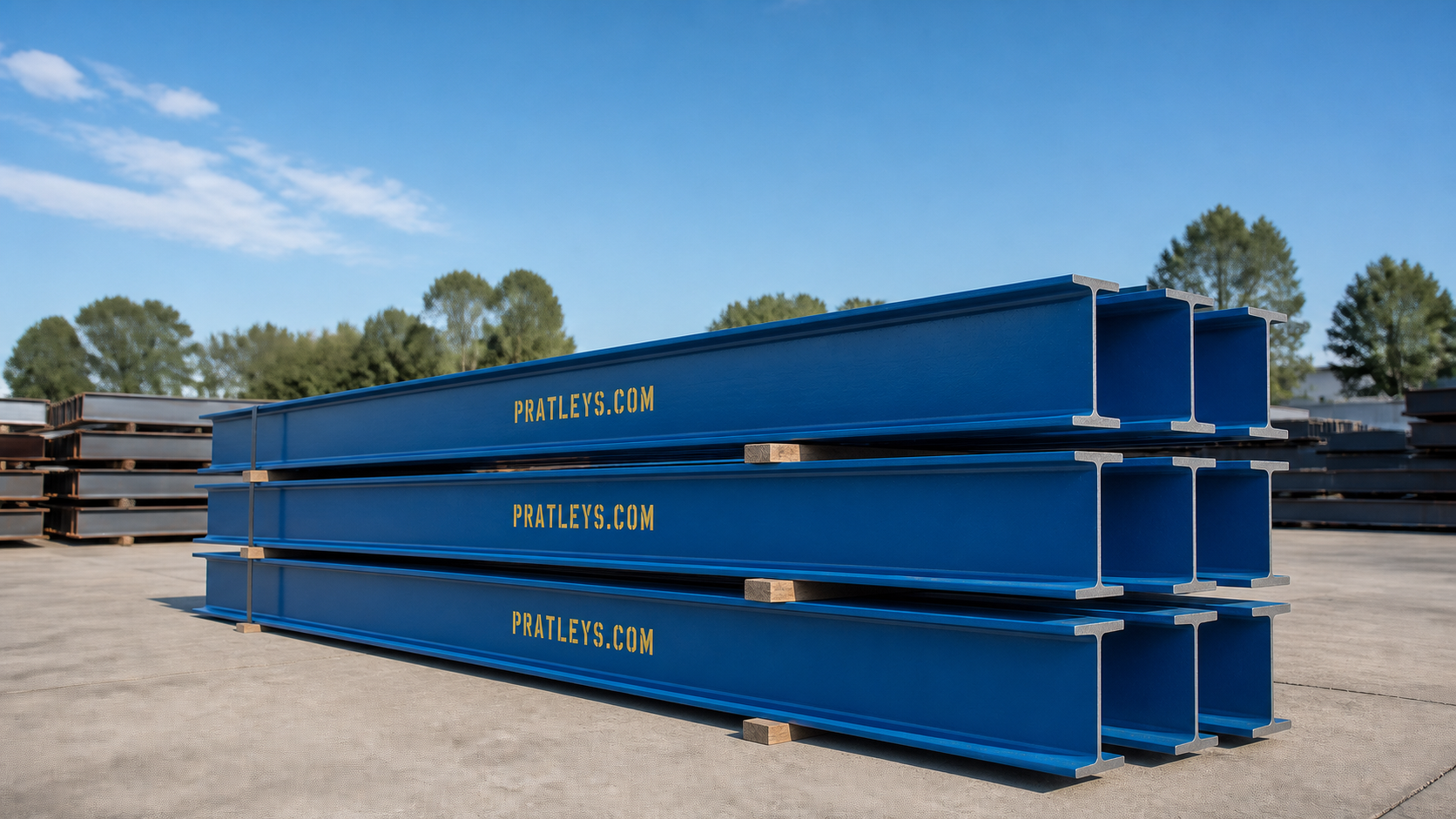
Visual guide only. Manufacture follows the dimensions in your configuration - please check them carefully before ordering.
This applies to every item in your basket. Changing it here updates the whole order.
Collection selected - delivery is not included. You must collect the whole order from Pratleys in a suitable vehicle once we confirm it is ready. Please arrange collection within a reasonable time.
Rolled steel angles, also known as angle iron or L-angles, are fundamental structural steel elements created through a hot rolling process. During manufacture, heated steel is passed through a series of rollers that shape it into an L-shaped cross-section with two legs (or flanges) meeting at a 90-degree angle. These angles come in various sizes, with legs that can be equal or unequal in length, and different thicknesses depending on the intended application.
The manufacturing process begins with steel billets that are heated to approximately 2,200°F (1,200°C). The hot steel is then progressively shaped through rolling mills, where the pressure and precise geometry of the rollers form the characteristic L-shape. This hot rolling process improves the steel’s strength and creates a uniform grain structure throughout the material.
In construction, rolled steel angles serve numerous essential purposes. One of their primary applications is in the creation of structural frameworks for buildings. They’re commonly used as:
Connection elements: Angles excel at joining different structural members together. They can connect beams to columns, create splice joints between sections, and serve as brackets for various connections. Their L-shape makes them naturally suited for these applications as they can be easily bolted or welded to both connecting surfaces.
Support members: In roof systems, angles often function as purlins (horizontal beams) supporting roof panels or as parts of roof trusses. Their shape provides excellent resistance to bending and twisting forces while maintaining relatively light weight.
Bracing elements: Steel angles are frequently used in diagonal bracing systems to provide lateral stability to buildings. They help resist wind and seismic forces by transferring these loads through tension and compression.
The versatility of rolled steel angles extends beyond primary structural applications. They’re also used in:
One of the key advantages of rolled steel angles is their excellent strength-to-weight ratio. The L-shaped cross-section provides good resistance to bending in multiple directions while using less material than solid sections. This makes them both economical and efficient in terms of material usage.
Steel angles are typically available in standard sizes specified by the leg lengths and thickness. For example, an L3×3×1/4 designation indicates an angle with 3-inch legs and 1/4-inch thickness. They’re usually manufactured according to ASTM standards, which ensure consistent quality and mechanical properties.
When selecting rolled steel angles for construction projects, engineers consider several factors including:
The durability and reliability of rolled steel angles, combined with their versatility and ease of fabrication, make them an indispensable element in modern construction. Their standardized production and widespread availability ensure they will continue to play a crucial role in structural engineering and building construction for years to come.
RSA angles can be ordered online in cut lengths from 1,000mm to 6,000mm. Choose your section size and enter the required cut length in the order builder, then select the available finish and fabrication options. Review the specification and displayed availability before adding it to your order.
If you would prefer to discuss your order with our experienced team then please contact the office on 0118 9757500.
Send the required angle dimensions, cut lengths, quantities and any fabrication requirements for a quote. The section and connections should match your project specification. Check the available options and date in the order builder before ordering.
SKU: RSA · Grade: S355 · Standard: BS EN 10025-2 · Max length: 6,000mm
Delivery is available within our 60-mile delivery area, excluding inside the M25, our excluded area east of the M25 and the Isle of Wight. Check your postcode in the order builder to confirm eligibility. Collection is also available.